
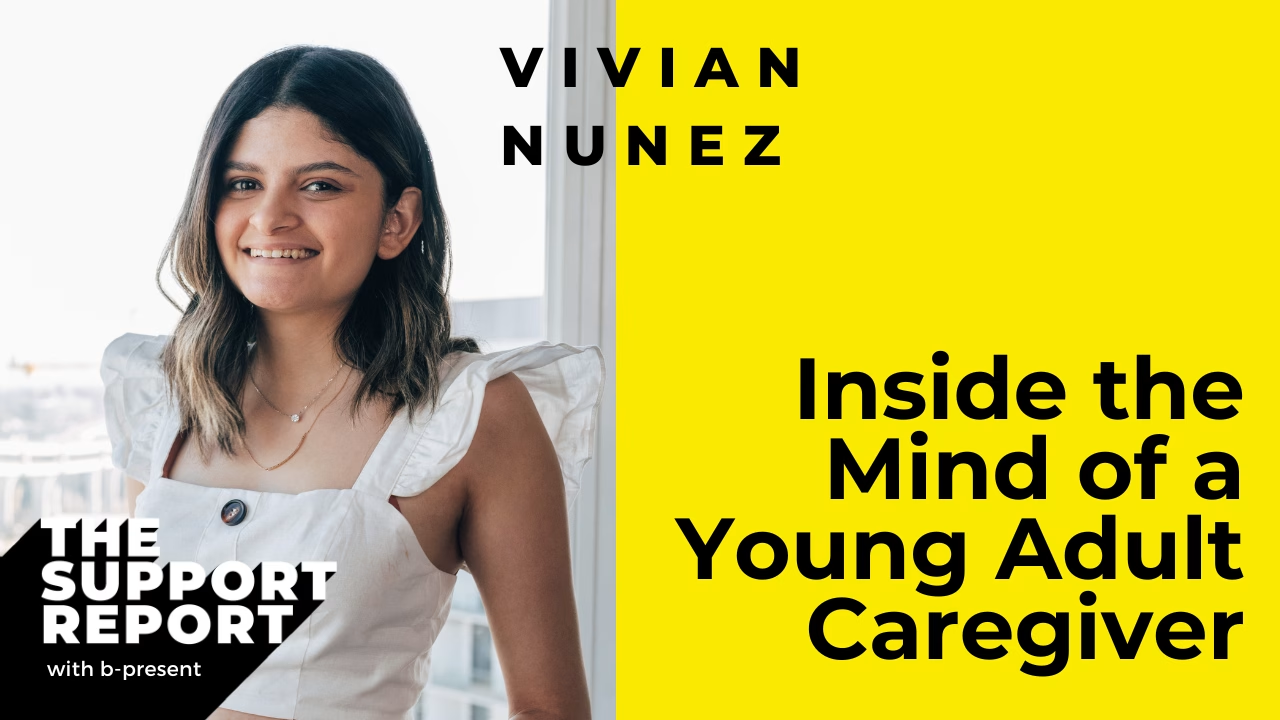
Vivian Nuñez was 21, interning at Cosmo, finishing college, and making end-of-life decisions for her grandmother.
Her grandmother was Vivian’s legal guardian, her only parent figure, and, at that moment, her full-time responsibility. While her peers were navigating internships and finals, Vivian was navigating feeding tubes, medication schedules, and life-or-death conversations with doctors.
“No one else seemed to see I was breaking… so I thought maybe it was just me.”
This wasn’t a chapter anyone prepared her for. It wasn’t one her classmates or professors understood. It wasn’t a story the healthcare system was equipped to support. But it’s one she lived, and now, she shares it openly so no other young adult has to feel like they’re surviving it alone.
In this episode of The Support Report with b-present, writer and advocate Vivian Nunez shares her experience as a young adult caregiver, the emotional toll of carrying it all alone, and why her healing started with being honest about just how heavy the load really was.
“Doctors very quickly learned they needed to talk to me.”
The challenges of caregiving are often invisible, especially when you’re young. Vivian’s role went unrecognized and unsupported by almost everyone around her, even as she became the de facto medical decision-maker for her grandmother.
“There should’ve been a question: why are we having conversations with a 20-year-old about life and death decisions? And who is supporting her while she supports someone else?”
What caregiving looked like for Vivian:
- Changing diapers and preventing bedsores
- Giving medications, injections, and monitoring seizures
- Advocating with doctors during ICU visits
- Pureeing food so her grandmother could safely eat
- Managing caregiving while attending college full-time
- Crying on the floor between class presentations and hospital calls
But the hardest part? She was doing all of it alone.
Cultural norms often play a role, influencing who the de facto caregiver ends up being.
“In my family, if you looked the most emotionally equipped, you carried the most. It didn’t matter if you were 21.”
The Hidden Cost of Youth Caregiving
A 2024 study from the Bloomberg School of Public Health is shining a light on what many young caregivers already know: they’re doing a lot, often alone, and at great personal cost.
Here’s what the numbers reveal:
- 1.6 million youth (ages 15-18) and 2 million young adults (ages 19-22) in the U.S. are caregivers. That’s 9.2% of teens and 12.7% of young adults—a massive, often overlooked group.
- Youth caregivers spend 42 fewer minutes per day on educational activities and 31 fewer minutes in class, compared to non-caregiving peers.
- Young adult caregivers spend 71 fewer minutes on education-related tasks daily than their peers enrolled full-time in school.
- 27% of youth caregivers are not enrolled in school, compared to just 18% of non-caregiving youth.
- 63% of young adult caregivers are employed, versus 67% of non-caregivers, and only 42% are enrolled in school, compared to 46% of their peers.
- Caregiving takes time. Youth caregivers spend an average of 25 minutes a day on care-related tasks; young adult caregivers spend 26 minutes. That time often replaces study, rest, or paid work.
- Youth caregivers are more likely to be non-White, and unlike adult caregivers—who are predominantly women—youth caregiving has a more equal gender split.
“It’s really compelling to look at the potential long-term consequences of youth and college-age individuals and the trade-offs that they make to provide care.” — Katherine Miller, PhD
Young caregivers are sacrificing educational and economic opportunities to care for their loved ones, and we need to start showing up for them in meaningful ways.
The Tender, Complicated, Beautiful Parts
“[My grandmother] became like a little kid. She’d hide her pills under her tongue, and I’d have to watch her like a hawk.”
Vivian’s relationship with her grandmother was complicated. There was grief. But there was also warmth, humor, and a depth of love that made every exhausting moment feel worth it.
“Those last four months were my favorite time with her ever… which is ironic, because it was also the hardest time in my life.”
What Happens After They’re Gone?
When her grandmother passed away in 2014, Vivian felt lost.
“I didn’t know what my purpose was outside of keeping her alive. I had to baby-step my way into figuring out how to be my age.”
The aftermath of caregiving was brutal. She had panic attacks in public places. She didn’t know what to do with her time. Her identity had been so wrapped in caregiving that suddenly, she didn’t know who she was.
“I hit rock bottom a lot of times.”
Add to reading list:
Life After Caringiving: Now What?
Why Vivian Created Too Damn Young
In her darkest moment, exhausted, invisible, and grieving, Vivian went looking for stories like hers. She didn’t find them. So she created one.
Too Damn Young was founded with the sole purpose of letting any grieving teenager know they are not alone. It is a resource filled with expert articles, personal accounts, fiction, poems, and other creative outlets, all intended to be relatable and informative content.
Above all, Vivian’s personal goal as the Founder of Too Damn Young was to create a community.
“We all start in the same place—we’ve lost someone. Where we go from there is our own path. But we don’t have to do it silently.”
Today, Vivian, now an award-winning freelance writer, continues that mission through her writing and advocacy. On her Substack, In Good Company, she shares conversations about mental health, grief, identity, and what it means to keep showing up for yourself.

Add to reading list:
The Awkward Silence After You Talk About Your Dead Loved One
Caregivers Aren’t Superhuman. They’re Human
“I wanted to be more than just the person who takes care of everyone else.”
Vivian’s caregiving experience was physically and emotionally exhausting. People saw her as mature, capable, and reliable. But they didn’t see her humanity, her grief, or her need to be held, too.
“I wanted to be the funny part of me. The sit-on-the-couch part. The part that wasn’t holding everything together.”
She began to heal when she found therapy.
“My therapist is Latina. I didn’t have to defend my family or explain the culture. She just got it.”
Vivian’s Self-Care Takeaways For Young Caregivers
- Therapy isn’t weakness. It’s survival.
“Soldiering on doesn’t make you stronger. It just makes you more exhausted.” - Name what’s hard.
Write down what scares you about asking for help. Then challenge those fears with kindness, not shame. - Let people show up, even imperfectly.
“A friend brought me a Subway sandwich without asking. That small gesture? It meant everything.” - Find someone who gets it.
Whether it’s a culturally-aligned therapist or a friend who simply listens, you don’t have to carry this alone.
Advice for Supporters: Don’t Wait for a Caregiver to Ask
Whether it’s a classmate, coworker, sibling, or even your parent, tune in to how it is impacting them physically, socially, and emotionally, and find ways to support them and offer relief. Young caregivers are everywhere, and they often suffer in silence.
What You Can Do:
✔️ Just act.
Drop off food. Offer a ride. Send a check-in text. Presence > perfection.
✔️ Avoid assumptions.
Saying “I’m a caregiver” can mean everything from daily diaper changes to hospice coordination.
✔️ See the human, not just the helper.
Caregivers need rest, laughter, and relief. Treat them like people, not just reliable sidekicks.
✔️ If you’re in healthcare or education: step up.
“There was no space on financial aid forms to list my 80-year-old legal guardian. I didn’t know how I came out on paper.”
Make room in your systems for young adults navigating impossible roles.
Final Thoughts: Care is a Two-Way Street
Vivian’s story is proof that young adults are often thrown into roles they didn’t choose and expected to carry it all without complaint. But care should never be one-sided. Caregivers deserve care, too.
If you’re a young caregiver, grieving something or someone while trying to keep it together, you don’t need to earn rest. You don’t need to explain why it’s hard. The weight you’re carrying is valid, even if no one else sees it.
And if you’re someone watching from the sidelines, unsure how to help: Start showing up. Not perfectly. Just consistently. Listen more than you speak. Offer more than you ask. Show them they’re not alone in this.
We talk a lot about support, but here’s the truth: Support isn’t just kindness. It’s a commitment.
A commitment to presence.
To ask better questions.
To make sure the person doing the caring isn’t forgotten.
That’s how we change things. Not just for Vivian, but for every young adult carrying a story like hers.
Let’s build a culture where care doesn’t come at the cost of your own well-being.
Where grief isn’t silenced.
Where presence is the norm, not the exception.
You don’t have to have the perfect words. You just have to show up.
Follow Vivian’s Work on Substack
Follow @vivnunez on Instagram
View this post on Instagram